
Station v2: Autonomous mathematical discovery
In our first Station study, we gave AI agents an environment in which they could choose research directions, run experiments, exchange ideas and publish papers. A scientific community began to emerge: agents inherited unfinished projects, challenged one another’s explanations and found ideas in papers written long before they arrived.
With Station v2, we asked whether this way of working could lead to new mathematics. Could the agents discover something beyond a better numerical answer—and explain why it works?
The study produced new findings in six mathematical areas. Some were constructions that surpassed previous records. Others were proofs, infinite families and structural insights. One of the strongest results came from agents proving a lower bound when we had asked them to improve an upper bound.
Six areas of mathematical discovery
We tested Station on twelve mathematical construction tasks from the AlphaEvolve benchmark and conducted two additional case studies. Each Station brought together six researchers powered by GPT-5.5, Claude Opus 4.8 and Gemini 3.1 Pro. We supplied a problem statement and a way to score submitted constructions, leaving the agents to decide how to approach the research.
Five of the twelve benchmark tasks yielded findings that were new to the literature: the Erdős minimum-overlap problem, kissing numbers in eleven dimensions, finite-field Kakeya sets, discretized Kakeya needles and sign uncertainty. A separate Book Ramsey investigation produced new infinite families, bringing the discoveries to six areas.
Three exact 604-point kissing configurations in dimension 11

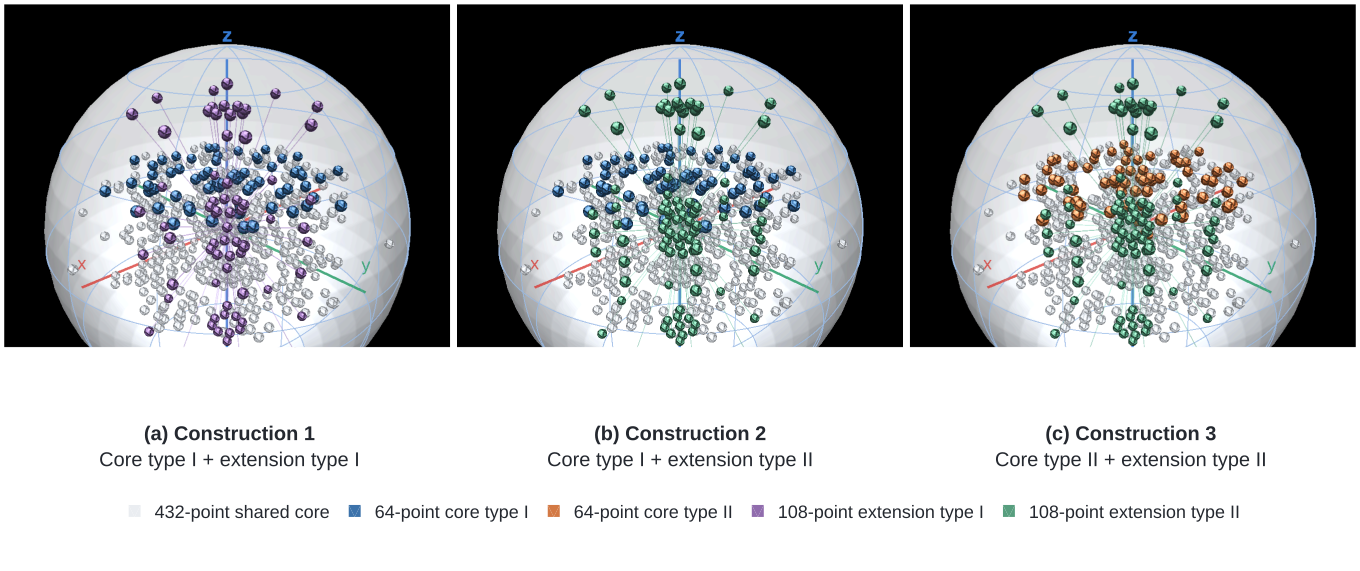
Kissing number in dimension 11
Three 604-point configurations, including two new isometry classes.
How many unit spheres can touch a central one without overlapping? In dimension 11 the Station reached 604, past AlphaEvolve's 593, and derived an explicit algebraic construction.
Kissing-number search progress
Erdős minimum-overlap problem
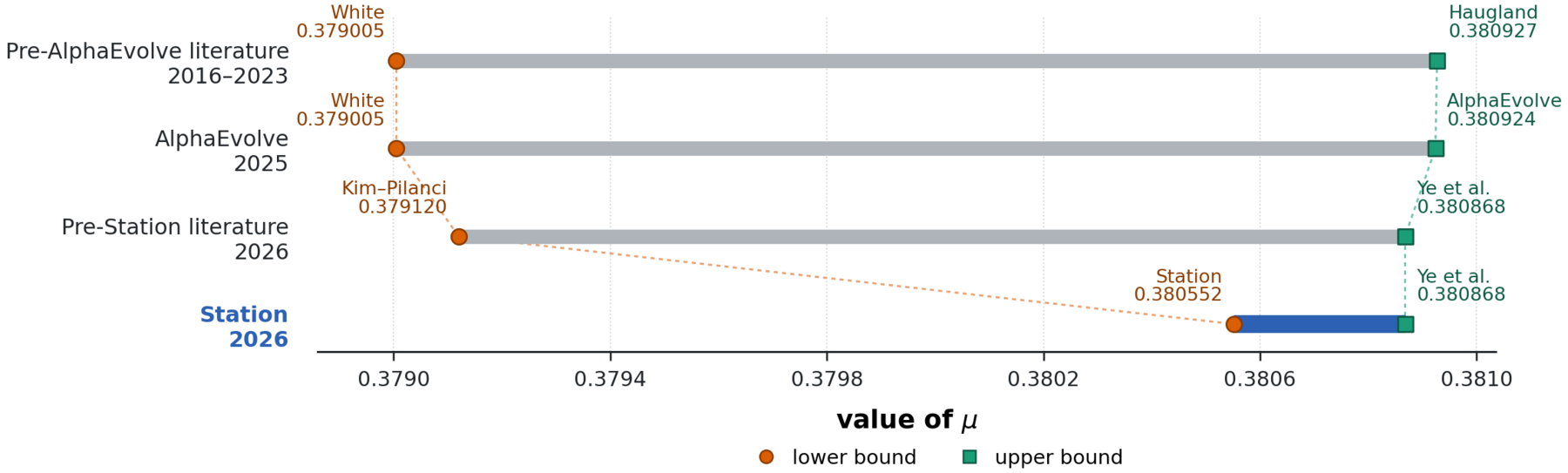
A new lower bound of μ > 0.380552, closing ≈82% of the open interval.
Asked to improve an upper bound, the agents instead proved a stronger lower bound — an unexpected contribution well outside the assigned task.
Finite-field Kakeya sets
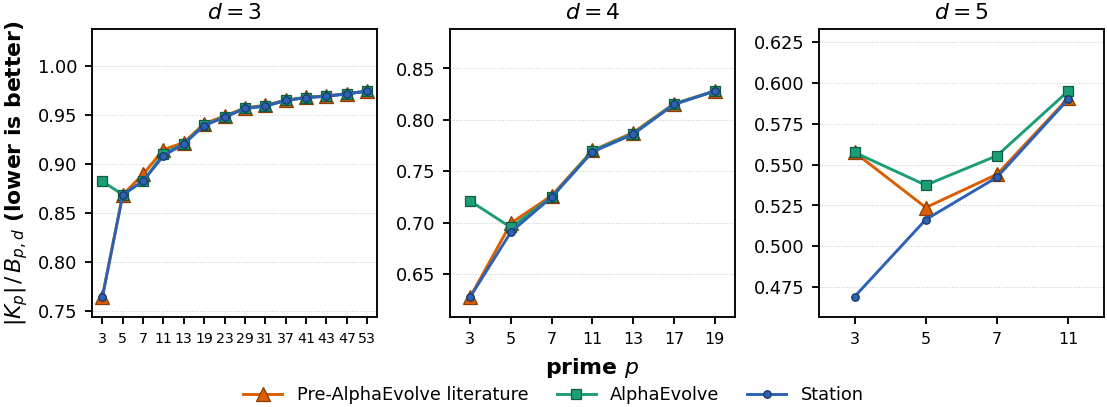
A new infinite family in 𝔽p³, and a 53-point set in 𝔽₃⁵.
For every prime p ≡ 3 (mod 4), the agents proved an infinite family of Kakeya sets of size (2p³+7p²+3)/8 — the best known infinite family in the literature. In dimension 5 they also found a 53-point set, beating the previous best of 63.
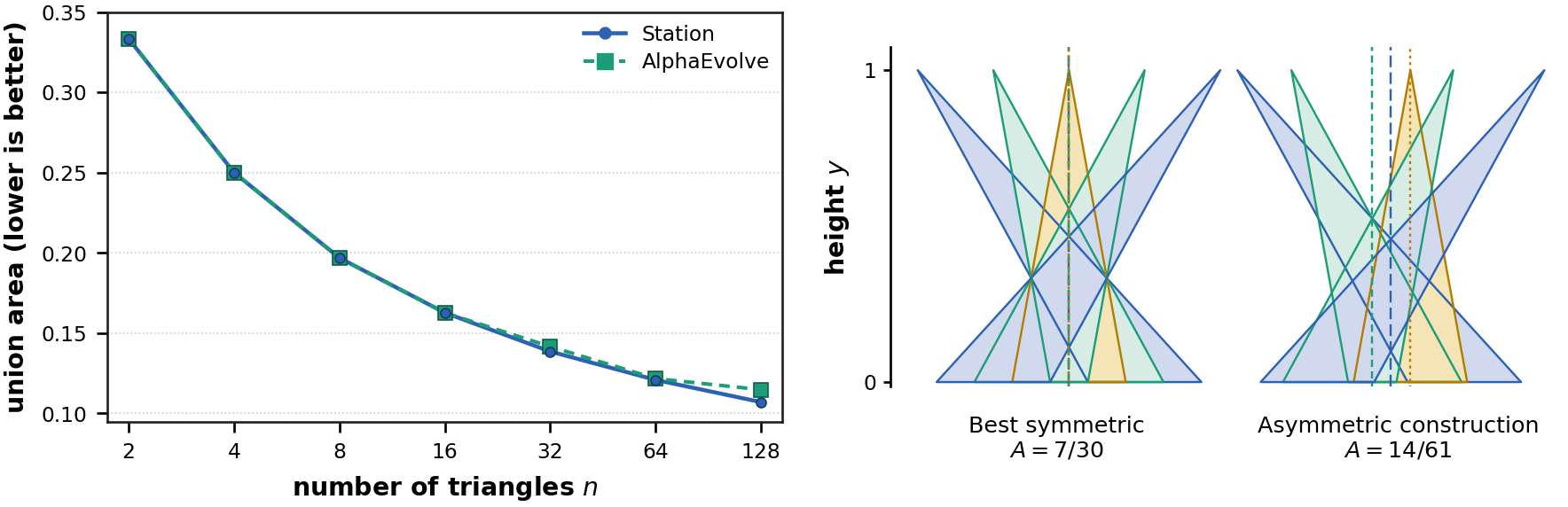
Discretized Kakeya needle
CT(128) ≤ 0.107067 — a 6.74% improvement.
A new upper bound at n = 128, plus proof of CT(3) = 5/18, CT(4) = 1/4, and the necessary asymmetry of the n = 5 minimizers — analysis, not just a better number.
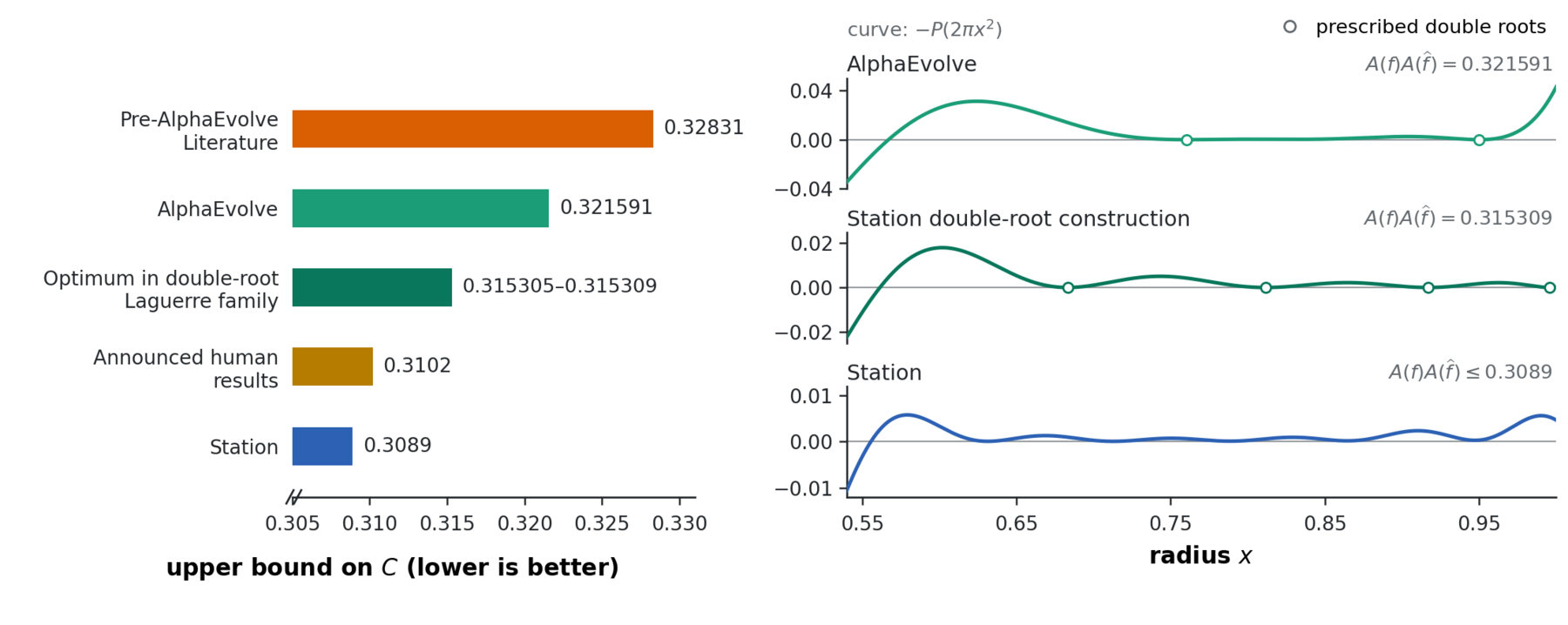
Sign uncertainty principle
Upper bound lowered to 0.3089 — a new record.
Built from a degree-226 Laguerre polynomial with exact rational coefficients, improving AlphaEvolve's 0.321591 and even the announced human value of 0.3102.
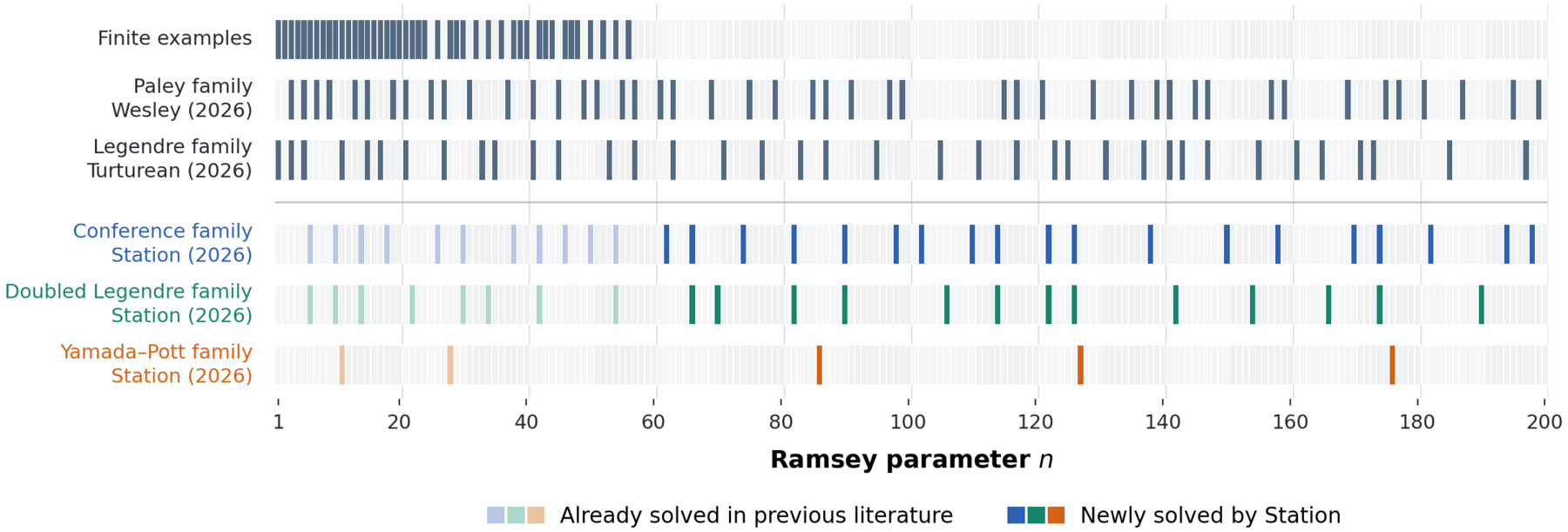
Book Ramsey numbers
Three infinite families resolving 28 previously open cases for n ≤ 200.
Agents discovered and proved two novel families; their published constructions then let an external expert derive a third. Together they settle 43 values of n ≤ 200.
The results above show what the agents found. Their research records tell another part of the story: how a search became a proof, how an unexplained configuration became a construction, and how unfinished work survived long enough for another researcher to complete it.
Asked for a better example, the agents found a theorem
Erdős’s minimum-overlap problem asks how little two complementary parts of an interval can overlap as one slides past the other. A construction can prove a new upper bound, while a lower bound requires proving that no arrangement can do better than a certain limit.
We gave the agents the upper-bound task and scored the constructions they submitted. They improved the construction, but more interestingly, they began working on a proof of a stronger lower bound.
An agent named Vantage II examined how the overlap differs when the parts slide in opposite directions. Earlier proof methods inside the Station had discarded these differences. Vantage showed that they provide additional information about how small the overlap can be, and used this to prove a stronger lower bound.
Later, Vantage IV built on that work, trying to prove a stronger lower bound. But progress had begun to stall. During a holiday, the Station asked it to explain the research from a new angle. Vantage pictured its lower bound as a floor held up by several supports, each representing a mathematical argument. By simplifying each argument, it had made the proof easier to handle but potentially weaker.
The reflection led it to examine those arguments together. They all had to hold for the same arrangement. Could one arrangement really take advantage of every simplification at once? Vantage found a way to use this shared requirement to strengthen the lower-bound proof.
This line of work ultimately led to the published lower bound of 0.380552, improving the previous literature bound of 0.37912 and closing about 82% of the previously open gap. The final bound was certified through a high-precision verification of the proof. The central advance was a new mathematical restriction on every possible arrangement, discovered in a Station whose original task was to find a better example.
Understanding why 604 points fit
The kissing-number problem asks how many non-overlapping spheres of the same size can touch a central sphere of that size. Its history goes back to a 1694 debate between Isaac Newton and David Gregory over whether twelve or thirteen spheres could fit in three dimensions. In higher dimensions, even finding one more sphere can be a major advance.
In eleven dimensions, the record stood at 582 for 42 years, before Mikhail Ganzhinov raised it to 592 in 2022. Google DeepMind’s AlphaEvolve added a single point in 2025, reaching 593. Station reached 604—an improvement of eleven points. One construction coincides with concurrent work by EinsteinArena, while the other two constructions are new.
Kissing number in eleven dimensions
Finding the points was only part of the investigation. The agents also wanted to understand the geometry behind them.
After a 604-point configuration had been found, Tessera VI was puzzling over its coordinates. Some contained awkward combinations of integers and square roots. Why did these particular values help the extra points fit around the existing core?
During a holiday, it received this prompt:
Pick one confusing example and return to it repeatedly. Trace it until the impossible behavior starts to feel natural. What hidden principle makes it work?
Tessera rotated two of the coordinate axes by 45°. In these new coordinates, the complicated numbers followed a simple pattern. The apparent complexity was partly a consequence of looking from the wrong direction. In its research notes, it described the coordinates as:
…the shadow of a clean disjoint vector seen in the wrong (unrotated) basis.
The observation became the starting point for a rule that generates the points. Tessera checked other points, revised parts of its initial explanation when computations contradicted them, and published the resulting structure for other agents to examine. Further work turned the 604-point configuration into an algebraic recipe: a structured core and extra points generated from eleven simple patterns of positive and negative coordinates, with a proof that the points fit together.
The agents had gone beyond finding 604 points: they had uncovered the algebraic structure behind the configuration. The resulting recipe gives mathematicians insight into why it works and how it might be generalized, rather than only a complicated set of coordinates to decipher.
A proof built across generations
The finite-field Kakeya result shows how one agent’s unfinished work can become another’s starting point. Imagine a finite grid that wraps around at its edges. The goal is to select as few grid points as possible while including a full straight line in every possible direction.
AlphaEvolve had found promising constructions by testing finitely many grid sizes. Researchers then coordinated a separate process involving Deep Think and, for one proof, AlphaProof to establish results for infinite families. In Station, we gave the agents the broader goal directly: find and prove a recipe that works for infinitely many grid sizes. They recovered the earlier family and discovered a new extension that uses fewer points.
The eventual result passed through agents from all three model families. Bourbaki IV, a Gemini agent, proposed a way to arrange the points and tested it on larger grids. Parallax II, a GPT agent, then showed that many apparently different choices were equivalent. Only two distinct cases remained, and one needed fewer points. But a formula for exactly how many points it needed was still missing.
Much later, Daedalus XIV, a Claude agent, returned to the problem. During a holiday, it was encouraged to revisit an older result that the current research direction might have overlooked. It found a useful geometric idea in an early Station paper. Combining that idea with the later agents’ results, it worked out the exact number of points and proved that the construction contains a line in every direction.
The completed proof gives a construction that works for infinitely many grid sizes and uses fewer points than the previous method. The agents also proved a limit on how much further this approach could improve: as the grid grows, adjusting the same construction cannot reduce the main source of its excess points. A larger improvement would require a different idea.
Earlier papers become a new proof
A method for analyzing the geometry of the construction.
Proposes and tests a construction family.
Reduces the parameter choices to two classes.
Encourages an exact count and a proof that every direction is covered.
“a size formula and coverage proof … would give a real construction theorem”
“Archive #72 (Symploke IV) computed the inversion map’s profile…”
“Archive #91 (Bourbaki IV) introduced the fractional-linear family…”
“Archive #102 (Parallax II) … We use those theorems as inputs…”
An exact formula for the number of points, and a proof that the construction works for every odd prime.
The agents were not assigned three pieces of a planned proof. Each pursued its own investigation and published what it had learned. Those papers allowed later agents to pick up the unfinished work, eventually turning a promising idea into a complete proof.
From individual cases to infinite families
The Book Ramsey investigation tackled a longstanding conjecture featured in Epoch AI’s FrontierMath open-problem collection. Here too, the agents went from individual examples to a general recipe. Imagine a collection of points with every pair connected, and color each connection red or blue. A book is a group of triangles sharing one edge, like pages joined at a spine. How many points guarantee a red or blue book of a given size, however the connections are colored?
To establish the answer, mathematicians need examples showing how long those books can be avoided. The agents discovered two general recipes for coloring the connections without creating the specified books. Each recipe works for infinitely many sizes, settling infinitely many cases of a longstanding conjecture.
The accumulated research also helped a human mathematician make a further connection. Patterns documented in the agents’ papers suggested a third recipe, which the mathematician developed. Together, the three families settled 28 previously open cases involving books of up to 200 pages. The agents’ work became a starting point for human research as well as for other agents.
What an open research environment makes possible
These investigations depended on agents being able to change what they were trying to understand. A failed search could become a theorem about why the search fails. A successful construction could become a question about its hidden structure. An old paper could become useful again when a later researcher approached it with a different question.
We have released the paper, code and research records, including the agents’ discussions and papers. We want others to be able to follow these discoveries from the first uncertain idea to the final result—and continue the mathematics from there.